Private tutoring
For a specific gap, two or three targeted sessions are often enough during the Toussaint break (the autumn half-term holiday around All Saints’ Day); an intensive course becomes useful when several prerequisites are shaky. Start by diagnosing the difficulty, then compare the options on practice, spacing and how the result will be measured.
Sébastien Lochon·23 October 2026·10 min read
Private tutoring
Work between two private tutoring sessions should be short, precise and tied to a difficulty spotted during the session. It might mean recalling a rule, starting an exercise alone or noting what is blocking them. If school homework is already enough, adding nothing is an acceptable decision.
Sébastien Lochon·23 October 2026·10 min read
Private tutoring
Before planning a catch-up programme, take 25 minutes to identify what is really holding your child back: a forgotten concept, a poorly understood method or a lack of independence. The diagnosis helps you decide between rest, targeted revision or support from a tutor.
Sébastien Lochon·23 October 2026·13 min read
Parents and follow-up
To build independence, follow the method rather than every exercise: watch whether the child starts alone, identifies what is blocking them and asks for help at the right moment. A single mark does not prove a lack of work. Ask questions about the approach, and step in mainly when the same difficulty keeps recurring.
Sébastien Lochon·23 October 2026·10 min read
Private tutoring
After a tutoring session, a parent needs five pieces of information: what was worked on, what has been acquired, what is still fragile, the work to do before the next session and the recommendation for what comes next. Vague feedback such as “it all went well” is not enough: these elements make it possible to decide concretely what to do next.
Sébastien Lochon·23 October 2026·10 min read
Methods and revision
Reading a correction is not enough: each mistake needs to become an action. In 15 to 30 minutes, work out why you went wrong, redo the question without looking at the solution, then practise on a variant. The marked paper then becomes a revision plan for the next test.
Sébastien Lochon·23 October 2026·10 min read
Private tutoring
Study skills tutoring at lycée (upper secondary school) works on organisation, learning strategies, methods for school tasks and self-assessment. Its aim is to diagnose the real blockage, then test strategies on actual lessons to make the student independent.
Sébastien Lochon·23 October 2026·8 min read
Private tutoring
In Terminale (the final year of lycée), private tutoring is effective when it targets a specific difficulty (a specialism, Philosophy, the Grand oral). Start in September for a gap identified in Première, or after the first assessments if the level is uncertain. One session a week is often enough for a targeted need, avoiding overloading an already busy timetable.
Sébastien Lochon·23 October 2026·13 min read
Parents and follow-up
A child may need private tutoring when their difficulties become repetitive (accumulated gaps, persistent mistakes, homework that takes too long). Identifying a specific, lasting blockage is more useful than a single bad mark. Targeted support helps consolidate fragile knowledge and avoid the “snowball” effect of gaps.
Sébastien Lochon·23 October 2026·11 min read
Methods and revision
Good school organisation rests on simple principles: start from real constraints, distinguish homework, revision and practice, and build in catch-up margins. An effective schedule must be adjustable and sustainable over the long term, not just ambitious in September.
Sébastien Lochon·23 October 2026·9 min read
School success and study choices
Getting stuck on functions in Seconde (the first year of lycée) often hides a gap in a collège prerequisite: calculating with negative numbers, substitution, reading coordinates, image/preimage vocabulary or switching between representations. To make progress, you need to pinpoint the exact step that fails and test the skill just before it. Mistakes can then be classified into four types: calculation, vocabulary, representation and strategy.
Sébastien Lochon·23 October 2026·9 min read
Private tutoring
A session report after a private tutoring session should let the parent understand four things without having attended: what was actually worked on, what the student now masters better, what remains fragile and what they need to prepare before the next session. The report does not need to be long, but it must be precise. “Good session, needs reviewing” gives little information; “simple equations are mastered, sign errors are still frequent, redo exercises 3 and 4 before Tuesday” makes it possible to act. Good follow-up therefore serves the parent, the student and the tutor who will prepare the next session, all at the same time.
Sébastien Lochon·23 October 2026·14 min read
School success and study choices
A difficulty in Maths does not mean a student is “hopeless at Maths”. In practice, you first need to distinguish three common mechanisms: a poorly mastered prerequisite, an unsuitable problem-solving method or insufficient practice. They can add up. A good diagnosis therefore does not start only from the mark, but from the mistakes: can the student carry out the basic step? can they choose a strategy? do they only succeed with help? do they repeat a mistake despite the correction? In twenty minutes, a few well-chosen exercises and an explanation out loud often make it possible to know which lead to work on first.
Sébastien Lochon·23 October 2026·12 min read
School success and study choices
A good method for the philosophy essay does not consist in mechanically applying a three-part plan. You first need to understand exactly the question asked, define its terms, bring out the problem it contains, then build a step-by-step answer based on relevant arguments, distinctions, examples and references. At the baccalauréat (the French school-leaving exam), the essay therefore assesses less the ability to recite a course than the ability to use your knowledge to deal with a specific question. The priority is simple: every stage of the paper must move the problem closer to a solution.
Sébastien Lochon·23 October 2026·15 min read
Private tutoring
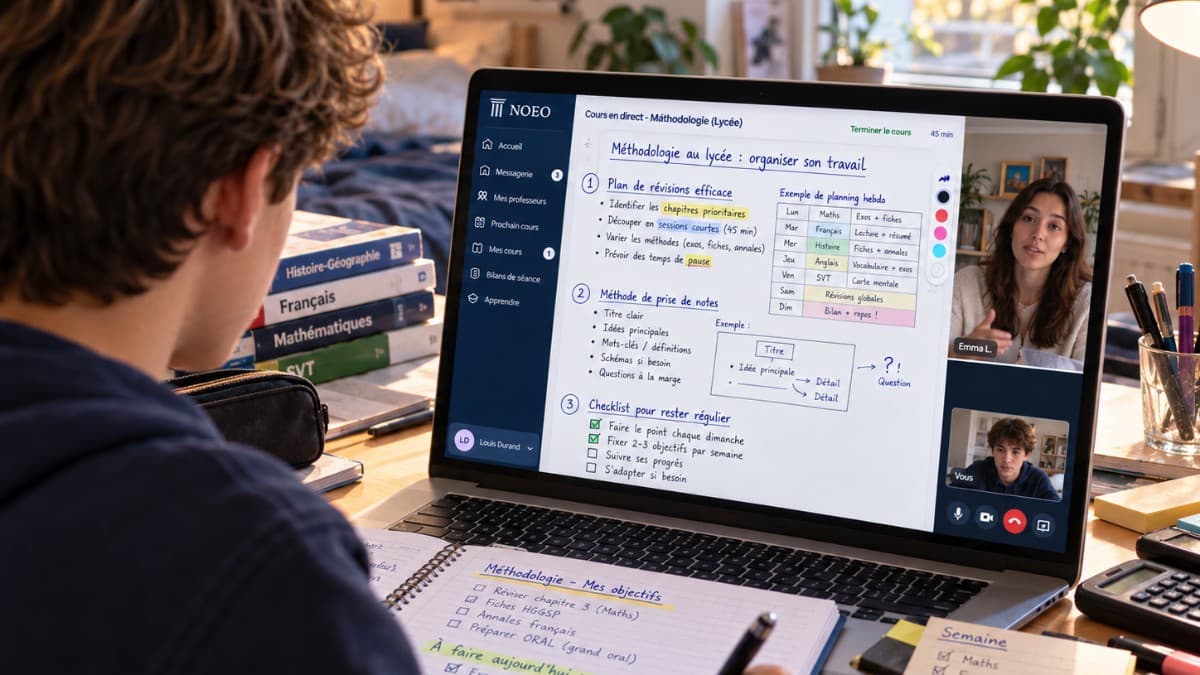
NOEO is a French online private tutoring platform designed to structure the whole learning relationship around the session: choosing or inviting the tutor, session plan, live tutoring, session report, documents, work to prepare, replays when available and revision tools. Its aim is not to replace the tutor with a platform or an AI, but to prevent each session from standing in isolation. The student keeps a thread of work, the parent has appropriate visibility and the tutor finds in their tutor space the information needed to prepare for and follow up with their students. NOEO is therefore aimed above all at those looking for ongoing support, entirely online.
Sébastien Lochon·23 October 2026·11 min read
Tutors
To find students for private tutoring, define a precise offer (subject, level, need and method) and create a credible profile with a professional photo and a concrete description. Promote your offer through targeted channels (network, platforms, communities) and reply quickly to requests. Natural recommendation, earned through serious support, remains the best long-term source of new students.
Sébastien Lochon·23 October 2026·14 min read
School success and study choices
Private French tutoring at collège (lower secondary school) should identify the difficulties precisely (reading, grammar, spelling, expression) in order to work on them methodically. Prioritise problems that affect several skills, such as a limited vocabulary or fragile syntax. One targeted session a week, with concrete exercises and explicit corrections, leads to measurable progress in autonomy and fewer recurring mistakes.
Sébastien Lochon·23 October 2026·13 min read
Private tutoring
Homework help suits students who understand their lessons but struggle to organise themselves or move forward alone. Private tutoring is suited to reworking a specific subject or skill in depth. The choice depends on what is really holding the student back: organising their work or mastering the knowledge.
Sébastien Lochon·23 October 2026·10 min read
Private tutoring
A one-off session is enough when the block is targeted and the student can then redo the exercise alone. A weekly session is justified when difficulties come back in several chapters or when supported practice is needed. The right reflex: start with a diagnosis, then adjust the pace according to progress.
Sébastien Lochon·23 October 2026·8 min read
Parents and follow-up
An average calculated on two or three marks varies sharply with each new assessment: a drop is not a diagnosis in itself. It becomes a useful signal when it highlights an identifiable, persistent difficulty, for example method errors that keep recurring. In that case, targeted action is justified.
Sébastien Lochon·23 October 2026·9 min read
Private tutoring
To choose between 1 hour and 90 minutes, look first at the goal of the session and the student’s ability to stay engaged, not just their age. One hour is often enough for a targeted difficulty or a young student; 90 minutes becomes useful for a dense chapter, a long piece of homework or exam preparation.
Sébastien Lochon·23 October 2026·9 min read
Methods and revision
Active recall means retrieving information from memory, without looking at your notes, and then checking your answers. It is a more effective method than simple rereading for long-term memorisation. To use it well, you need to space out recall sessions and use your mistakes to target the gaps.
Sébastien Lochon·23 October 2026·12 min read
Parents and follow-up
Good communication between a parent and a private tutor should be regular, factual and focused on the student’s goals. The parent needs to know what was worked on, what is improving, what is still blocking and what the next step is; they do not need to step into every detail of the session. From the start, it is therefore important to clarify roles, choose a main channel and agree on a pace for follow-up. After a session, a few precise pieces of information are better than a long debrief: the goal worked on, the difficulty observed, any work set and the priority for what comes next. The student should gradually remain the main actor in their own support.
Sébastien Lochon·23 October 2026·10 min read
School success and study choices
To prepare effectively for the bac de français (the French exam taken at the end of Première), you need to work on three dimensions in parallel: the method for the written exercises, precise knowledge of the works and texts studied, and regular oral practice. Rereading your notes is not enough. In the written exam, the student must be able to build a commentary or an essay within a time limit; in the oral, they must explain a text, answer a grammar question and then defend a chosen work. Preparation should begin during the Première year, with short practice sessions that gradually become timed. The aim is not to learn model answers by heart, but to become able to draw on the right knowledge alone when faced with a new topic or extract.
Sébastien Lochon·23 October 2026·16 min read