Private tutoring
For a specific gap, two or three targeted sessions are often enough during the Toussaint break (the autumn half-term holiday around All Saints’ Day); an intensive course becomes useful when several prerequisites are shaky. Start by diagnosing the difficulty, then compare the options on practice, spacing and how the result will be measured.
Sébastien Lochon·23 October 2026·10 min read
Private tutoring
Work between two private tutoring sessions should be short, precise and tied to a difficulty spotted during the session. It might mean recalling a rule, starting an exercise alone or noting what is blocking them. If school homework is already enough, adding nothing is an acceptable decision.
Sébastien Lochon·23 October 2026·10 min read
Private tutoring
Before planning a catch-up programme, take 25 minutes to identify what is really holding your child back: a forgotten concept, a poorly understood method or a lack of independence. The diagnosis helps you decide between rest, targeted revision or support from a tutor.
Sébastien Lochon·23 October 2026·13 min read
Private tutoring
The choice between weekly tutoring sessions and an intensive course depends above all on the goal: regular follow-up suits difficulties that build up gradually, while a concentrated course meets an upcoming deadline or a well-defined need. The total cost, how the hours are spread and the work planned after the sessions are key criteria for comparing the two options.
Émilie Zajdman·23 October 2026·12 min read
Parents and follow-up
To build independence, follow the method rather than every exercise: watch whether the child starts alone, identifies what is blocking them and asks for help at the right moment. A single mark does not prove a lack of work. Ask questions about the approach, and step in mainly when the same difficulty keeps recurring.
Sébastien Lochon·23 October 2026·10 min read
Methods and revision
Consolidating within 24 hours rests on four steps: put the concept into your own words from memory, check only what is missing, apply it in an exercise, then plan a later retrieval. The aim is not to reread everything, but to actively retrieve the information.
Pierre Basile·23 October 2026·9 min read
Methods and revision
Watching a replay in full gives a sense of familiarity without checking that you can redo the reasoning. A more effective 20-minute revision: try to remember, rewatch only the part that is blocking you, then redo the task and test your understanding on a similar question.
Pierre Basile·23 October 2026·9 min read
Private tutoring
After a tutoring session, a parent needs five pieces of information: what was worked on, what has been acquired, what is still fragile, the work to do before the next session and the recommendation for what comes next. Vague feedback such as “it all went well” is not enough: these elements make it possible to decide concretely what to do next.
Sébastien Lochon·23 October 2026·10 min read
Methods and revision
Reading a correction is not enough: each mistake needs to become an action. In 15 to 30 minutes, work out why you went wrong, redo the question without looking at the solution, then practise on a variant. The marked paper then becomes a revision plan for the next test.
Sébastien Lochon·23 October 2026·10 min read
Private tutoring
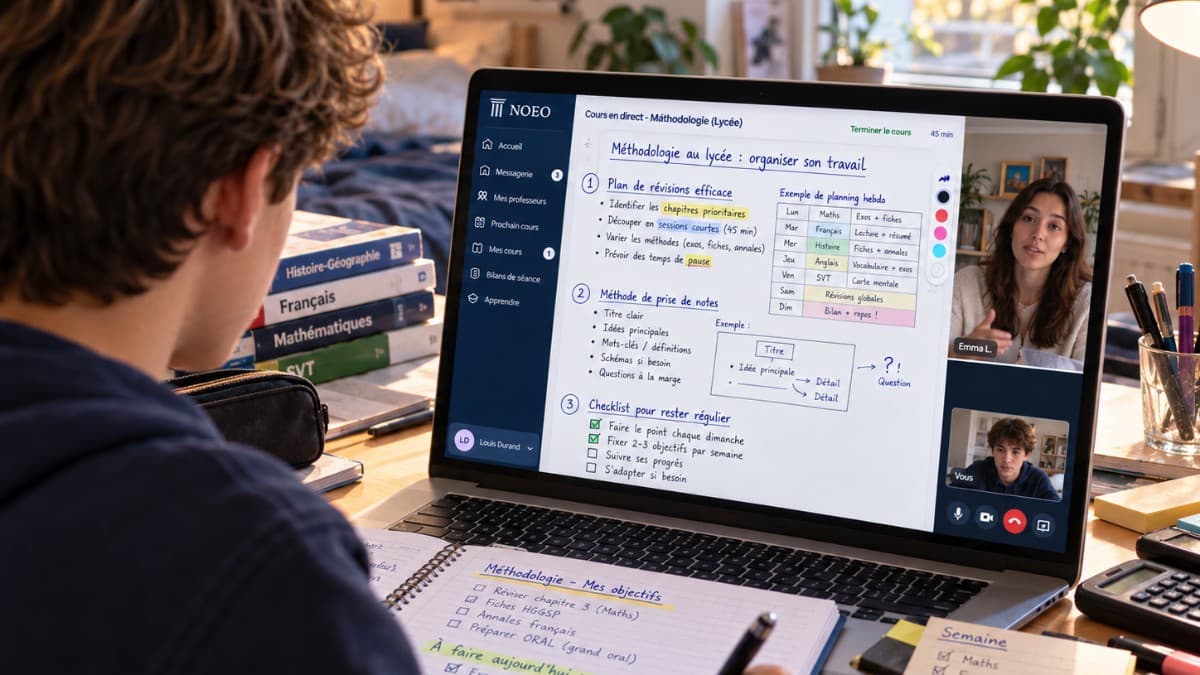
Study skills tutoring at lycée (upper secondary school) works on organisation, learning strategies, methods for school tasks and self-assessment. Its aim is to diagnose the real blockage, then test strategies on actual lessons to make the student independent.
Sébastien Lochon·23 October 2026·8 min read
School success and study choices
A useful diagnosis means working back from the visible mistake to the missing prerequisite: calculation, signs, the distributive property, setting up equations. Rather than redoing all of collège, test a few targeted skills and find the first breaking point. The mark is not enough: look at the marked paper and at exercises done cold to tell a one-off difficulty from a lasting blockage.
Émilie Zajdman·23 October 2026·10 min read
Methods and revision
AI can help a student by rephrasing instructions, explaining a concept or offering a hint, but the student must remain the author of their work and be able to redo it without the tool. The deciding test is simple: what can the student still explain and do once the screen is closed?
Pierre Basile·23 October 2026·13 min read