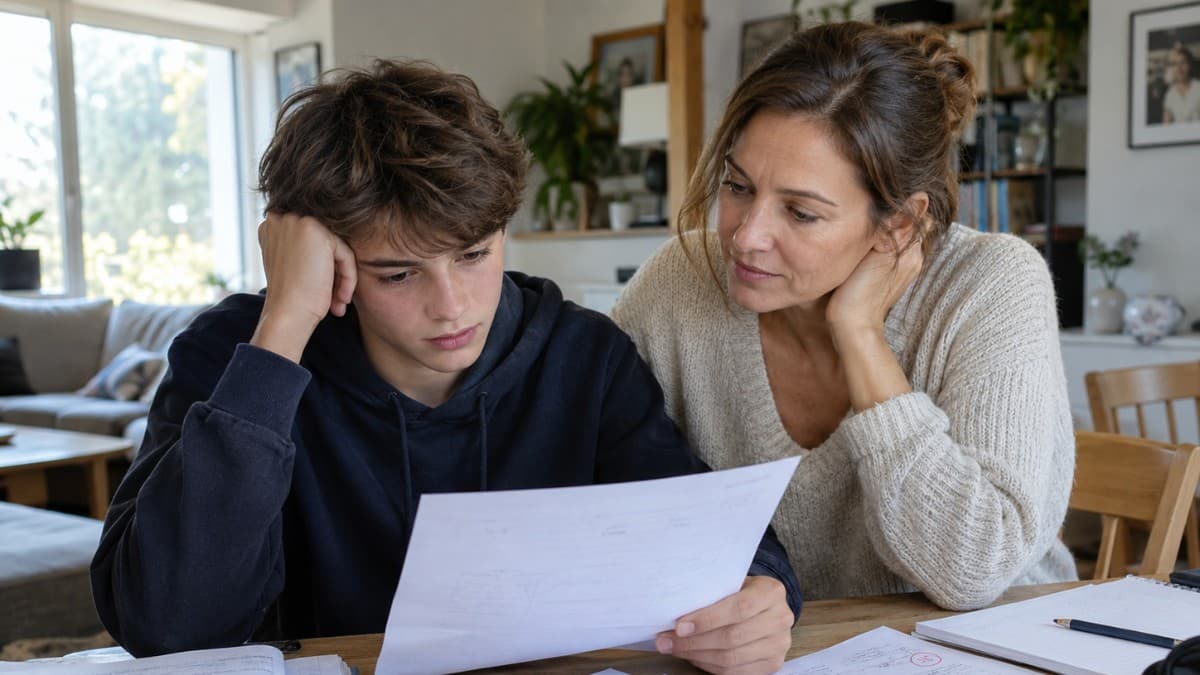
Supporting a child through school does not mean checking every piece of homework. A parent’s role is above all to understand the situation, maintain a stable framework and step in when difficulties become lasting.
This section offers guidance on following results, talking about school, responding to a drop in motivation, choosing the right support and preserving the student’s confidence. It also covers the relationship with tutors and teachers, and how to assess progress beyond grades alone.
NOEO gives parents visibility over sessions, session reports, work to prepare and next steps. The articles explain how to use this information without adding needless pressure or gradually taking away the student’s independence.
Parents and follow-up
To build independence, follow the method rather than every exercise: watch whether the child starts alone, identifies what is blocking them and asks for help at the right moment. A single mark does not prove a lack of work. Ask questions about the approach, and step in mainly when the same difficulty keeps recurring.
Sébastien Lochon·23 October 2026·10 min read
Parents and follow-up
An average calculated on two or three marks varies sharply with each new assessment: a drop is not a diagnosis in itself. It becomes a useful signal when it highlights an identifiable, persistent difficulty, for example method errors that keep recurring. In that case, targeted action is justified.
Sébastien Lochon·23 October 2026·9 min read
Parents and follow-up
Good communication between a parent and a private tutor should be regular, factual and focused on the student’s goals. The parent needs to know what was worked on, what is improving, what is still blocking and what the next step is; they do not need to step into every detail of the session. From the start, it is therefore important to clarify roles, choose a main channel and agree on a pace for follow-up. After a session, a few precise pieces of information are better than a long debrief: the goal worked on, the difficulty observed, any work set and the priority for what comes next. The student should gradually remain the main actor in their own support.
Sébastien Lochon·23 October 2026·10 min read
Parents and follow-up
A low first mark does not mean a drop in level: it reflects a particular situation (chapter, method, stress). What matters is the same mistakes recurring across several assessments despite regular work. Analyse the marked paper and identify the nature of the difficulties before reacting.
Sébastien Lochon·23 October 2026·10 min read
Parents and follow-up
To restore a student’s confidence, you need to let them succeed again at tasks that remain demanding but achievable, understand their mistakes precisely and see concrete progress. Encouragement alone is not enough if the student keeps failing at exercises that are too difficult. Start by identifying what they can already do, set a precise goal, provide only the help needed and then gradually withdraw it. Praise strategies, corrections and independence rather than a label such as “you’re gifted”. If fear of school comes with lasting distress, bullying or significant anxiety, academic support should not replace help from a qualified professional.
Sébastien Lochon·23 October 2026·9 min read