German

Private tutoring in German

German calls early on for a grammatical rigour that other languages put off: cases, article declension and the position of the verb change the meaning of a sentence. Students who fall behind have often let these foundations crumble. Rebuilding them methodically, then reusing them orally, restores confidence.

Choose your level

Tutors

A tutor in German

On NOEO, finding a tutor is free: you only pay for the sessions you take. Create your account for free to see their full profile and message them.

Manon

Soutien Scolaire de la primaire au lycée

New tutor5 years of experienceAccepting new students
Subject searched:
Allemand
Also:
Mathématiques · Physique-Chimie
+ 18 other subjects

SVT / Biologie · Français · Anglais · Histoire-Géographie · Informatique / Programmation · Latin · Sciences de l'ingénieur · SES · Culture générale · Aide aux devoirs · Méthodologie et organisation · Soutien scolaire général · NSI · Brevet · Orientation · BAC · TOEIC · TOEFL

Levels:
Primaire · Collège · Lycée · Adulte

€24 / hourAll-inclusive price, paid by the student or their family. No hidden fees.
Full profile and messages with a NOEO account.

The curriculum

Why take tutoring in German?

Topics covered

  • Cases and declensions
  • Position of the verb
  • Strong verbs
  • Subordinate clauses
  • Guided speaking practice

What you work on in sessions

  • Choose the right case after a preposition or a verb
  • Place the conjugated verb in a main clause and in a subordinate clause
  • Conjugate strong verbs in the preterite and the perfect
  • Hold a simple conversation about daily life and school

Cases that are not yet secure

Nominative, accusative, dative, genitive: as long as choosing the case remains hesitant, every sentence becomes a source of mistakes. Targeted work settles this for good.

Vocabulary that fades

Compound words and the gender of nouns need regular memorisation. Spaced revision between sessions avoids relearning everything before each test.

A language dropped too soon

Many students fall behind in 3e or Seconde (the last year of collège and the first year of lycée), just as the grammar gets denser. Support at that precise moment avoids giving up a language that is much sought after later on.

Rates

Tutoring in German from €24 an hour

The rate shown is the final price paid by the student or their family, NOEO commission included. It varies from tutor to tutor, and nothing is added on top: no application fee, no matching fee, no service fee.

€0 sign-up fee · €0 subscription · you only pay for the sessions you book.

What NOEO brings

What you get on top of the tutoring session

Tutors vetted before they go live

NOEO reviews each tutor’s application before their profile appears. The tutor then declares the subjects and levels they teach, and never appears under any they have not declared.

Live tutoring, on Noeo Live

Sessions take place online, with the whiteboard, documents and conversation in one place. No travelling, and your choice of tutor no longer depends on distance.

A session report after every session

The tutor writes a session report at the end of every session, readable by the student and, for a minor, by their parents. Their payout stays on hold until that report has been sent.

The replay and documents, after the session

The session recording and the documents used stay available in the student’s space: a concept that was not quite understood can be revisited without waiting for the next session.

Revision material between sessions

From a session and its report, the student generates their revision sheet, flashcards and quiz in Noeo Learn, then revises at their own pace.

Follow-up suited to the student

An independent student keeps their space to themselves. For a minor, parents see the sessions, session reports and messages, and decide how much independence to give them.

Read

On the same subject, in the NOEO Journal

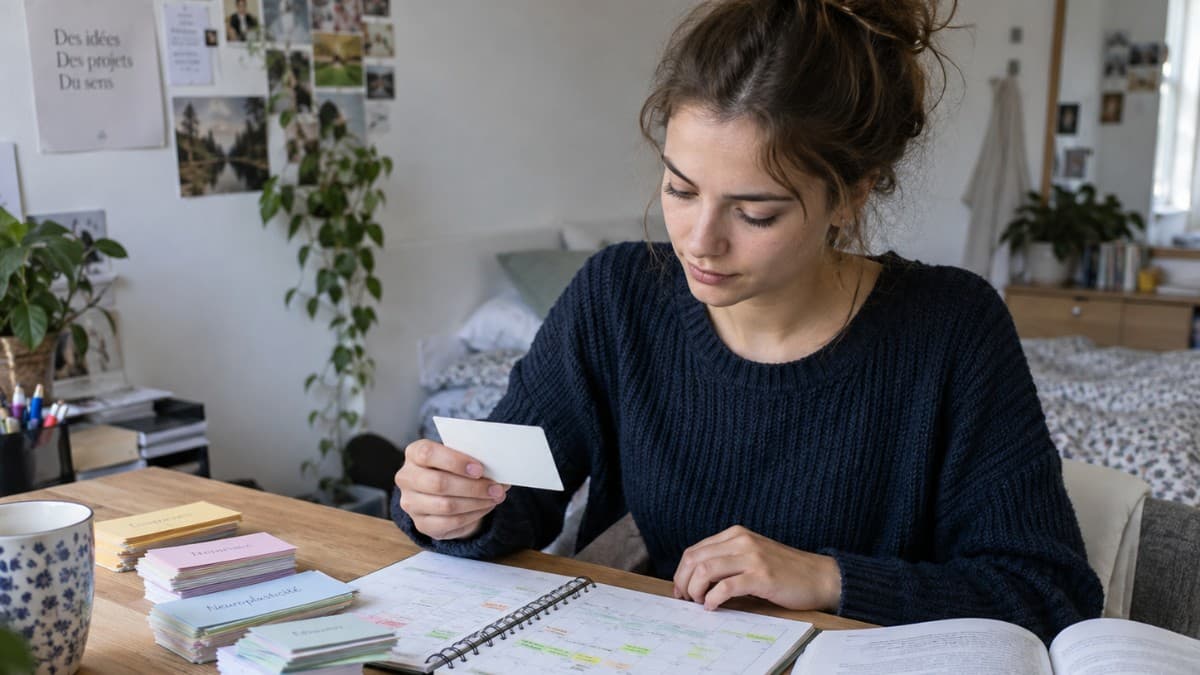
Student creating and sorting flashcards at her desk, with an exercise book, open books, a laptop and several piles of cards.

Methods and revision

Flashcards: how to create and use them without wasting time

A flashcard is useful when it asks a precise question, when the student looks for the answer before checking it and when the cards are reviewed at spaced intervals. Stick to one idea per card and vary the types: definitions, distinctions, examples and common mistakes. For complex skills, flashcards remain a complement to practice, not a substitute for it.

Pierre Basile23 October 202611 min read
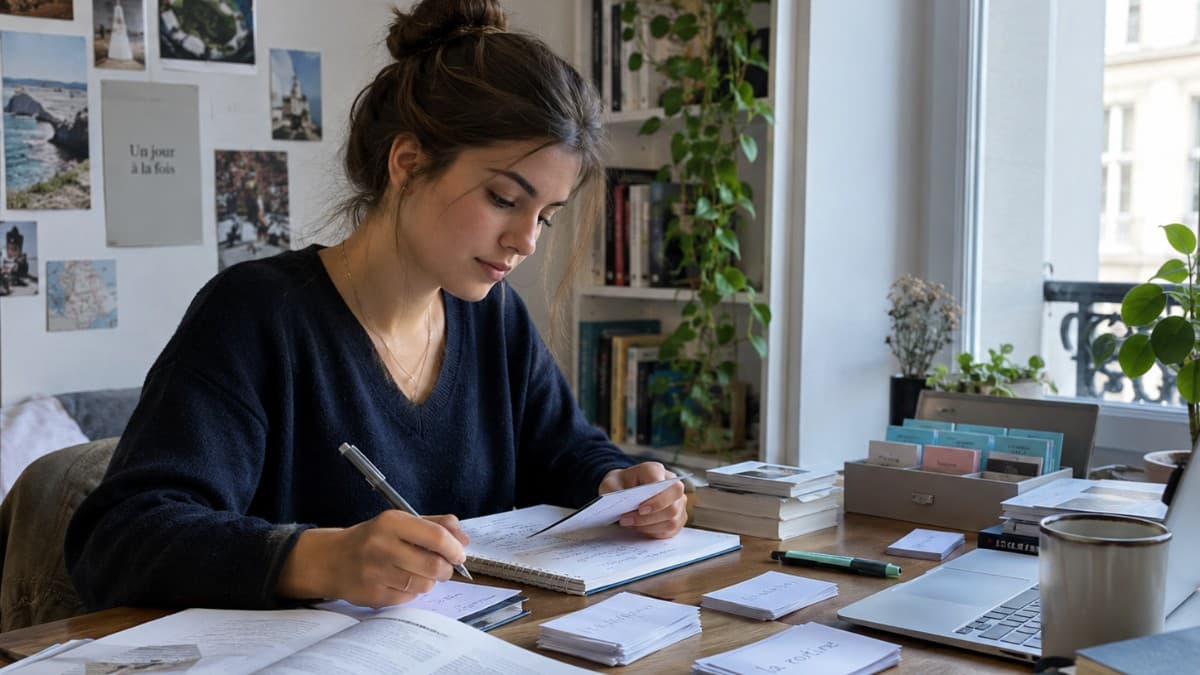
Student revising with flashcards organised by topic and a schedule, alongside her notes and an open textbook.

Methods and revision

Spaced repetition: how to memorise better over several weeks

Spaced repetition means reviewing a piece of knowledge several times, leaving time between each review, rather than concentrating everything into a single session. There is no universal schedule: intervals should be adapted to the deadline, the content and the difficulty encountered. A simple rule: no answer, come back soon; a hesitant answer, a moderate delay; a precise answer, space it out further.

Pierre Basile23 October 202610 min read
Student revising with active recall, using question cards, an exercise book and open textbooks on their desk.

Methods and revision

Active recall: the revision method that makes the brain retrieve information

Active recall means retrieving information from memory, without looking at your notes, and then checking your answers. It is a more effective method than simple rereading for long-term memorisation. To use it well, you need to space out recall sessions and use your mistakes to target the gaps.

Sébastien Lochon23 October 202612 min read

Frequently asked questions

Your questions about tutoring in German

Are the German sessions suited to bilingual sections?

Yes. The pace there is faster from 6e (the first year of collège): the tutor helps keep up with it without letting grammar gaps settle in.

Is German harder than English?

Its grammar is more demanding at first, but very regular. Once cases and verb position are mastered, progress speeds up.

Can we prepare for a stay or an exchange?

Tell the tutor: they will then steer the sessions towards everyday listening and speaking.

Do you have to learn declensions by heart?

Tables help, but use fixes them better: short sentences, repeated and corrected, make the endings automatic. The tutor alternates between the two.

How do you memorise the gender of German nouns?

By learning each noun with its article, and by grouping the endings that signal a gender, such as -ung, -heit or -chen. It takes regular work, done between sessions.

Take action

Find the tutor who suits your needs.

Create your account for free to see their full profile and message them. You then make an informed choice about who to start with.

€0 sign-up fee · €0 subscription · you only pay for the sessions you book.