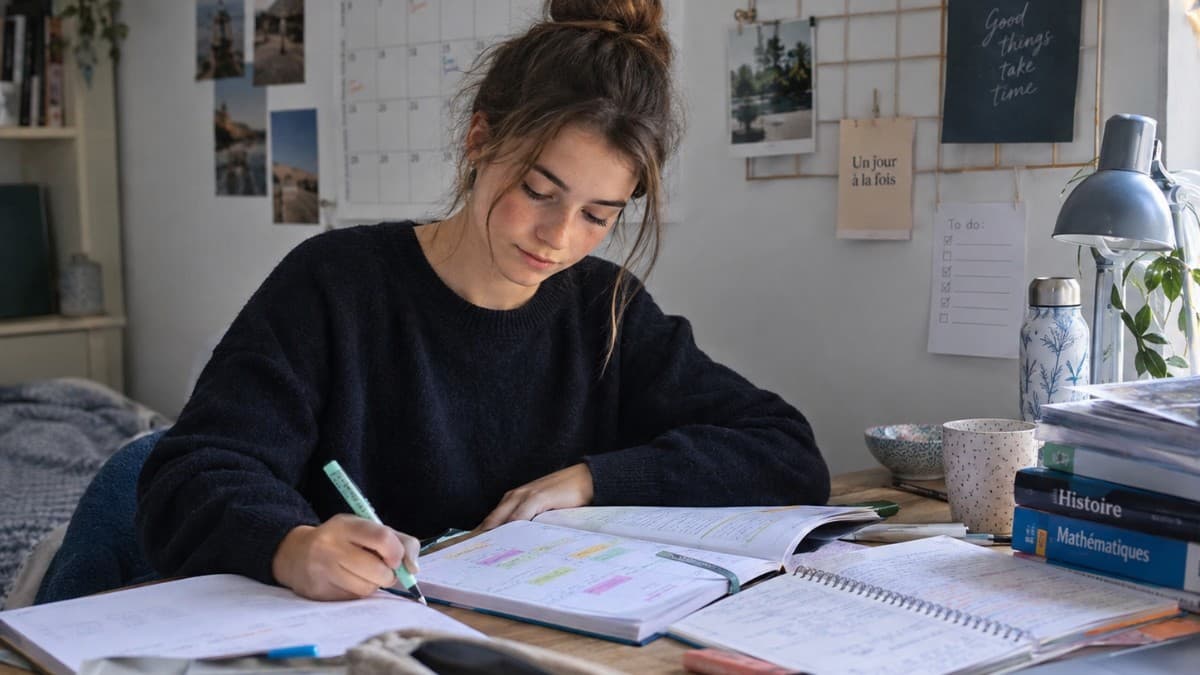
A good study method should help the student understand, memorise and reuse what they learn. It also has to be simple enough to apply regularly, including during busy periods.
This section brings together practical methods for organising homework, building a realistic schedule, taking notes, memorising a lesson, preparing for a test and revising for an exam. It also covers common mistakes: passive rereading, sessions that run too long, unrealistic schedules or revision started too late.
The techniques are explained step by step, with practical examples. The aim is not to impose a single method but to help each student build an organisation suited to their level, their subjects and their difficulties.
Methods and revision
An end-of-session quiz checks immediate understanding, but passing it does not prove that the student will be able to reuse the concept later. To reveal the real gaps, you also need to test the student after an interval (the next day or a few days later), without notes, then check the shaky points before the next session.
Pierre Basile·23 October 2026·13 min read
Methods and revision
A maths flashcard should contain a precise, checkable piece of information: a definition, a formula with its condition, an automatic skill or a pitfall. Exercises, on the other hand, are for learning to choose a method, calculate and justify. After a session, select three to five cards, then practise on real problems.
Émilie Zajdman·23 October 2026·10 min read
Methods and revision
For the Toussaint holidays (the autumn half-term break), start with a quick diagnosis, then keep only one or two difficulties that are genuinely blocking. Alternate short reviews, targeted exercises and days without schoolwork. The aim is to return to school with fewer blocks, not with an overloaded holiday schedule.
Sébastien Lochon·23 October 2026·10 min read
Methods and revision
A realistic revision schedule starts from the exact content to master, not from a number of hours. List the concepts, sort them by how well you know them, spread recall and exercises across the slots you genuinely have available, and test yourself in conditions close to the real test. Always leave a little slack to absorb the unexpected.
Sébastien Lochon·23 October 2026·10 min read
Methods and revision
A private tutoring session replay is not something to watch passively: it is for finding a specific explanation again. To make progress, you locate the useful passage, pause before the solution and try to redo the reasoning alone. It complements notes and exercises; it does not replace them.
Pierre Basile·23 October 2026·8 min read